
BY JACKIE WELLBORN
Clematis are commonly perceived as challenging to plant and care for, but in reality, they are quite manageable. I grow many types of clematis in my yard and have about 30 plants. Over the years, I’ve acquired a wealth of tips and tricks. Here, I debunk four common myths about clematis and provide facts to have you growing clematis like a pro.
Myth #1: Clematis are difficult to grow.
Fact: They need a little care in the beginning, but then will thrive.
When planting, dig a large hole, add a mix of soil and compost, and plant the clematis about 1-2 inches below the level of the soil in the pot. Planting a little deeper will encourage more branching and, as a result, more blooms. The roots need to stay moist during the first year.
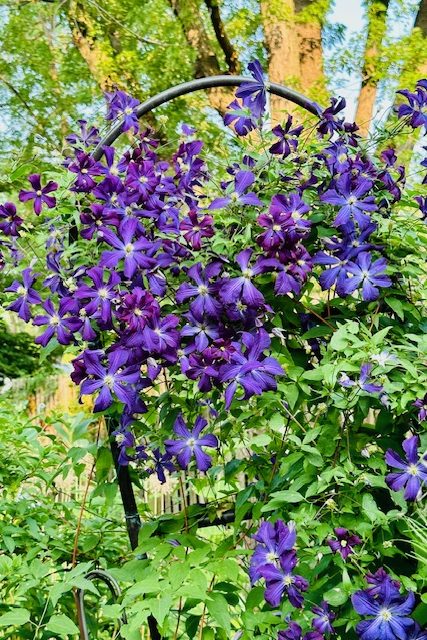
Tip: Big-box stores often sell clematis in 4-inch pots. The plants are usually very young and often won’t make it through the first winter. If you purchase these, put them in a larger pot for the summer and pamper them. In the fall, stick that larger pot into the ground and wait until spring to transplant the clematis in the garden, where it will have a much better chance of surviving its final planting. I prefer to purchase all of my clematis in ½- or 1-gallon-size pots.
Myth #2: Clematis need their “feet in the shade and heads in the sun.”
Fact: All clematis will grow in full or partial sun, but most won’t produce many flowers in shade.
I often see gardeners using companion plants to shade the roots of the clematis, but this actually takes nutrients from the clematis. Instead, put a 2-3 inch layer of mulch around the roots to protect them.
Myth #3: Pruning clematis plants incorrectly can kill them.
Fact: Clematis can be pruned and most will need it at some time, but not all clematis varieties should be pruned the same way.
Clematis are classified into three groups, each requiring different care.
- Group 1 blooms only on old wood. They are not usually sold in our 5/5b zones because the old vines tend to die during the winter.
- Group 2 blooms on old and new wood. If the old vines have lived through the winter, they will produce sparse growth. Later in the summer, on new growth, the blooms will be larger and produce showy flowers. Prune in early spring, cutting out only the dead wood.
- Group 3 blooms only on new wood. In early spring (March), the vines should be cut down to about a foot from the ground, removing all of the vines above the cut. Group 3 is the most reliable clematis in Iowa. They come in many colors, shapes, and sizes. Group 3 is also the only group of clematis not susceptible to wilt. This article provides information on clematis wilt. Probably 20 or so of my clematis are group 3.
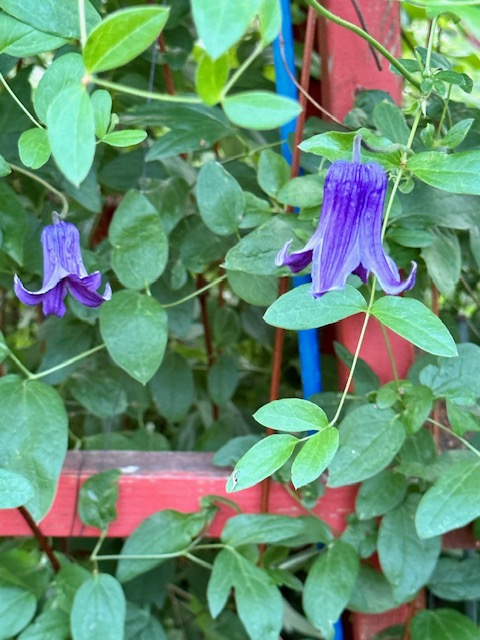
Myth #4: Clematis need a certain amount of sunlight and a particular type of soil.
Fact: Clematis are quite adaptable. They will have many flowers if grown in full sun and fewer in partial shade. Clematis adapt to most soils, but will do better with good, well-drained soil.
Tips: After pruning in early spring, lightly fertilize the soil around the plant, making sure it’s not too close to the roots.
Once the clematis has leafed out at the end of April or early May, fertilize with a high-phosphorus fertilizer (middle number). High phosphorus fertilizer helps the roots produce more blooms. An excellent high-phosphorus fertilizer is rose food. My personal favorite is tomato fertilizer. It’s high in phosphorus and relatively inexpensive. Do NOT use “blue” fertilizers like Miracle-Gro, as it has the wrong nutrient balance and doesn’t supply the necessary trace elements. It’s sometimes said that using the blues to feed clematis, instead of compost and a high-phosphorus fertilizer, is like feeding it vitamins instead of a balanced diet.
If you want flowering clematis all year, put two different clematis on a structure, like a group 2 and a group 3. One will bloom in the spring and the other in late summer. I use two or more clematis on a structure to maximize space for more clematis.
It takes several years for clematis to grow to their final size. Hence the adage:
First year they sleep
Second year they creep
Third year they leap
With the correct knowledge and a bit of patience, you will enjoy the beauty of your clematis for years to come.
 Johnson County Master Gardeners of Iowa