
By Melissa Serenda
I’ve been growing calatheas for more than 20 years; during that time I’ve watched them go from a relatively uncommon houseplant to a genus with a reputation as lovely but fickle heartbreakers. Though they can certainly be more fussy than many tropical plants that are kept in homes, they’re still enjoyable and fascinating to explore.
Calatheas1 and their relatives in the family Marantaceae (arrowroot or prayer plants) have a charming habit of folding up their leaves at night; the common name of prayer plants comes from the motion of the leaves resembling hands folding in prayer. This motion is accomplished by a swollen node at the base of the leaf blade called a pulvinus, which regulates the leaf movement via water pressure such that the leaves move to a more upright position at night, and open out to a horizontal position during the day.
Another distinctive characteristic of calatheas is their striking coloration, particularly among the varieties that have become popular houseplants. Many have bold patterns, like C. makoyana and C. lancifolia, or a reddish tint to the underside of their leaves, like C. rufibarba and C. ornata. There are also a number of cultivars, like ‘Fusion White’ (a cultivar of Calathea leitzei) with white variegation and a purple underleaf, and several cultivars of C. roseopicta, such as ‘Dottie’, ‘Corona’, and ‘Medallion’.
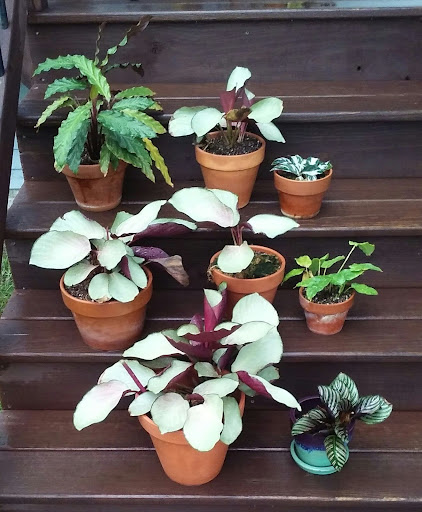
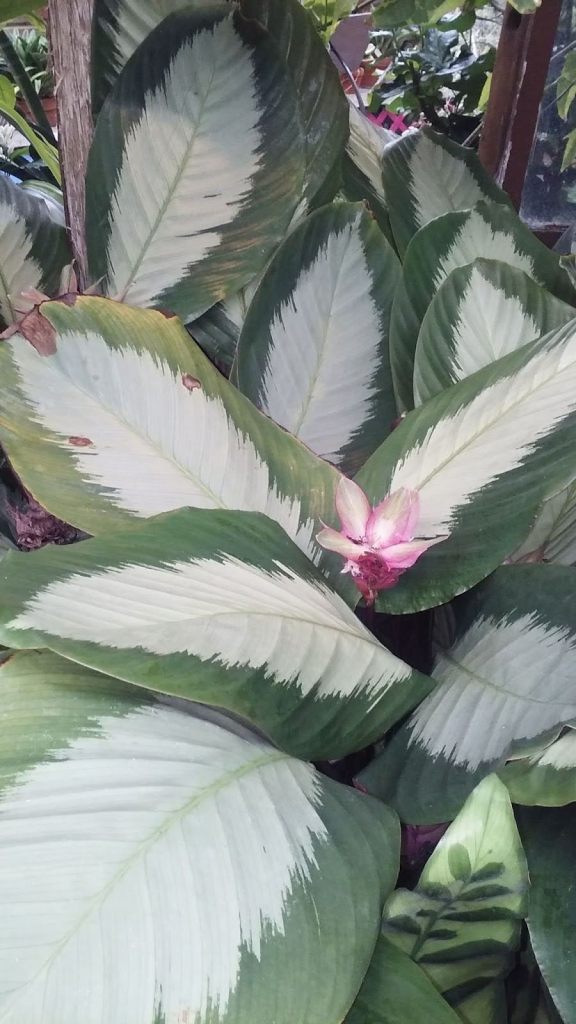
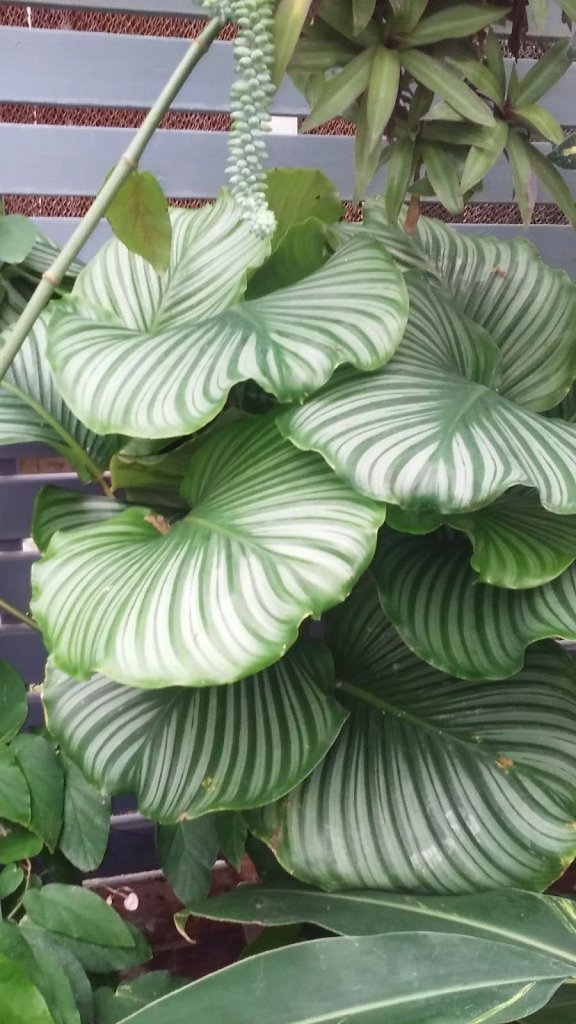
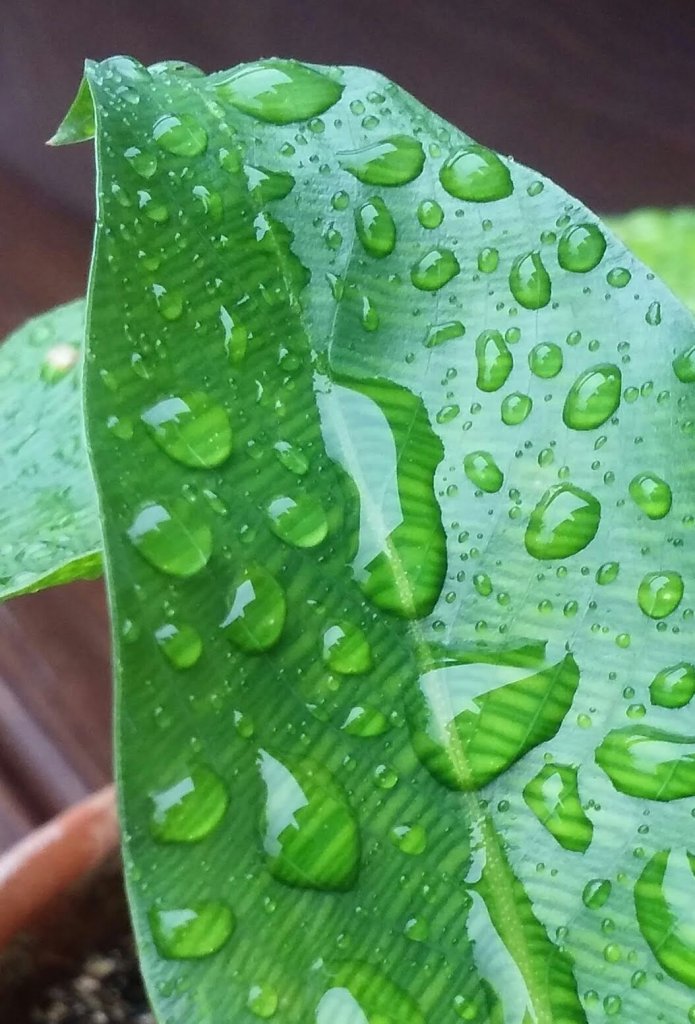
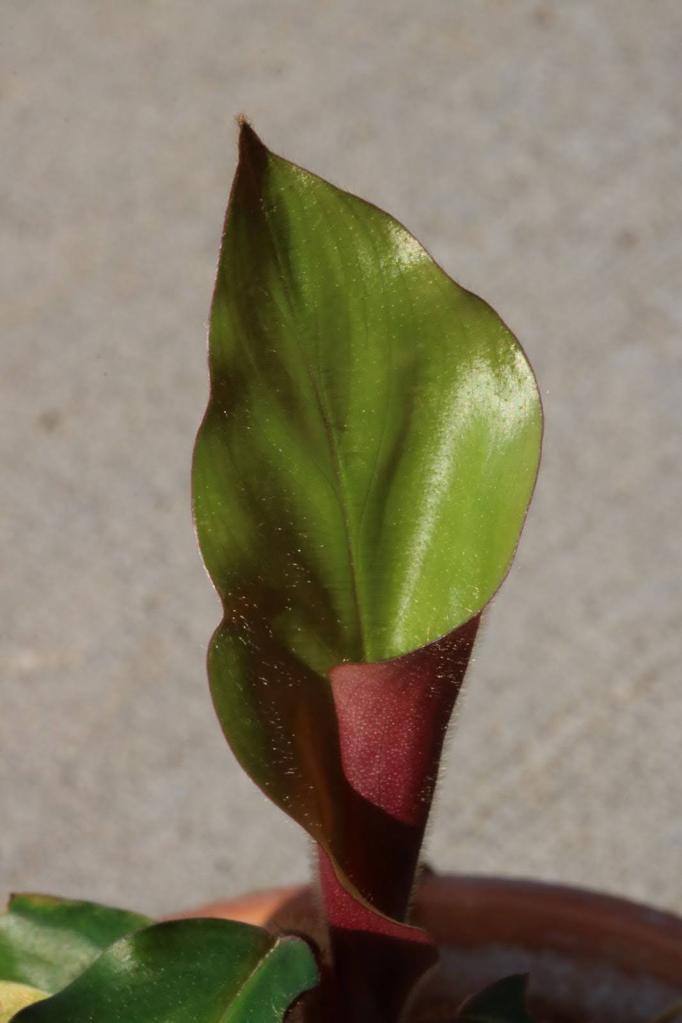
Photos/Melessia Seranda. Calatheas-Collection: Top left: A few of the calatheas from my collection, enjoying a summer rain shower on the front porch. Top right: C. picturata (?), photographed at the Greater Des Moines Botanic Garden in 2019. Bottom left C. orbifolia, photographed at the Greater Des Moines Botanic Garden in 2019. Bottom center: Raindrops on a leaf of C. musaica, from my collection. Bottom right: An unfurling young leaf of C. rufibarba, from my collection.
Calatheas have a (somewhat deserved) reputation as being very difficult to care for. Some varieties are more difficult than others, and I confess that I am simply not able to keep some of the roseopicta-type calatheas alive.
Like any houseplant, it’s important to look at where these plants would live in the wild and try to mimic those conditions as closely as possible in your house. Calatheas are plants of the tropical rainforest understory, living in the shade of taller trees, with high humidity and not terribly fertile soil.
Because of this, they don’t like direct light. I keep mine happily in a north-facing window; some are near a south-facing window but set back far enough that the direct sun never hits them. You can also use a sheer curtain in a window to help screen out direct light if necessary.
Calatheas are sensitive to fluoride and salts in water, so it’s recommended to water exclusively with distilled or rainwater and fertilize sparingly. They like high humidity, which can be challenging in our climate-controlled houses. Pebble trays are often recommended; you can also cluster your plants together so their transpiration helps with ambient moisture in the air, or add a humidifier to the room (this works best in a smaller contained area). For more diminutive varieties, you can keep them in a terrarium or other enclosed, glass-walled cabinet.
There are a lot of different recommendations for soil mixtures for calatheas; you can experiment and find what works best for you and your plants. The important thing is that it drains well, but also retains moisture without being too soggy. I like to use clay or terra cotta pots instead of plastic or glazed, because it allows the moisture to evaporate from the soil more quickly (I tend to overwater). Some mixes that I’ve seen recommended:
- 1/3 soil mix (no added fertilizer), 1/3 coconut coir, 1/3 perlite (this is what I use generally)
- 1/2 potting soil, even mix 1/2 even mix of orchid bark, perlite, and peat moss
- Standard cactus mix (if you’re a heavy waterer)
Common Issues
Pests: Spider mites, thrips
A great way to deal with both of these pests is to keep the humidity up. I also do a weekly wipedown of all my plants, though eventually I gave in and got a spinosad spray. (Monterey Garden Insect Spray is what I used; I’ve seen others recommend Captain Jack’s Deadbug Brew. Be sure to read and follow instructions carefully.) Then I drenched every calathea I had out in the garage on a nice day, and again 10 days later. That seems to have done the trick, but I still do the weekly wipedowns if for no other reason than it keeps me in tune with the plants.
Crispy brown leaves/edges
These are often caused by humidity that’s too low, or too much fertilizer/using tap water. You can buy distilled water, or collect rainwater/snowmelt. If you’re serious about calatheas, you can invest in a distiller. I fertilize sparingly, usually diluting the recommended amount to ¼ or so. CSome people use worm castings sprinkled on or mixed into the soil.
If calatheas are thirsty, the sides of their leaves will curl up as they try to conserve water. They’ll usually recover with a nice drink, but let them stay dry for too long and those leaves may not recover.
One important thing to remember is that everyone’s conditions are different. I’m telling you what works for me, and you might just as easily find someone who does things completely differently. You sometimes just have to try your best, and if your plant doesn’t seem happy try something else (or a different variety!).
1As a quick aside: many plants that had been in the genus Calathea were reclassified in 2012 to a different genus, Goeppertia, based on DNA sequencing. Some 200 species were moved from Calathea to Goeppertia, with about 60 remaining as Calathea. I, like many fans, continue to use Calathea out of habit/convenience, though many common calatheas are now more accurately Goeppertias.1
 Johnson County Master Gardeners of Iowa