
By Alice Linhart
For years my family has spent summers vacationing in Crested Butte, Colorado, known as the wildflower capital of the state, to reconnect with and hike in the beautiful West Elk Mountains. A lot of my family members work in the sciences and many of us are interested in identifying and photographing wildflowers, so we’ve spent many happy hours in the mountains during wildflower season.
Nestled in the mountains just a few miles from Crested Butte is Gothic, home of the Rocky Mountain Biological Laboratory. According to its website, RMBL is a biological field station where, since its founding in 1928, scientists have been conducting field research in pristine wilderness at nearly 10,000 feet. Thousands of students and scientists have conducted research here, making the ecosystems around Gothic some of the most intensively studied in the world and making RMBL a world-renowned center for scientific research and education.
Last summer as we vacationed in Crested Butte, a few of us decided to participate in a two-hour wildflower hike at the RMBL to learn more about this extraordinary place. On a beautiful, sunny morning in the mountains, we met our guide, Rick Reavis, the author of the “Rocky Mountain Wildflower Guide of Crested Butte, Colorado and Beyond.” Rick is a retired horticulturist who has spent summers volunteering at RMBL since the 1980s. With his wealth of knowledge, Rick guided us around the campus, giving us some history, pointing out wildflowers and discussing some previous and ongoing studies.
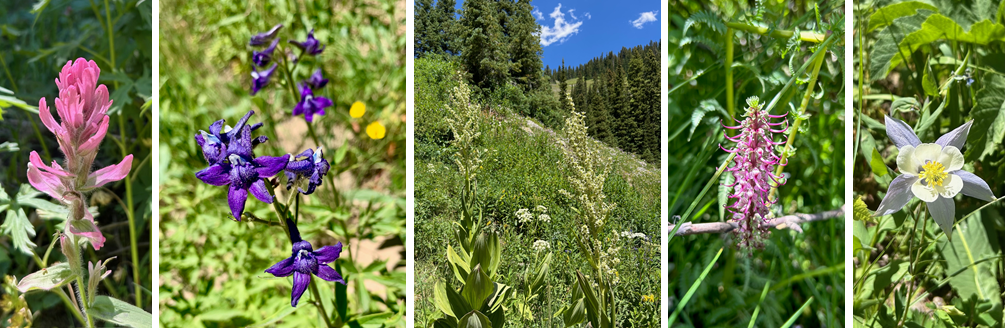
◦ Our first wildflower was a larkspur which had been involved in a study that found that injecting its flowers with saline produced more seeds.
◦ Monkshood plants are entirely poisonous and were used by Native Americans to make poison arrows.
◦ Sneezeweed was so named as the flowers were crushed and used as snuff by coal miners in Crested Butte to facilitate expelling coal dust after a day in the mines.
◦ Still being studied, the Wyoming paintbrush has a chemical in its roots that encourages plant diversity: where this flower occurs, many other species are close by.
◦ Studies also examine the effects of elevation on the sex of Geranium richardsonii. Geranium populations were found moving up in elevation and more flowers are female-only.
◦ One of the most amazing studies we heard about involves the corn lily, or false hellebore (Veratrum californicum), that contains toxic alkaloids that if ingested by pregnant lambs during a specific point in gestation can birth lambs with a single-centered eye, like a Cyclops.
We enjoyed our hike and tried hard to absorb everything Rick talked about. The experience definitely piqued our interest – not just in wildflowers, but in all of the research being done at the RMBL.
According to its website, “The RMBL sustains our quality of life by accelerating discoveries about the ecosystems that replenish the world’s air, water, and food supplies.”
If you would like more information about the RMBL, below are links for its website and a National Geographic article from March 14, 2023 (subscriber paywall).
https://www.nationalgeographic.com/magazine/article/phenology-seasons-climate-change-feature
A wildflower hike at the Rocky Mountain Biological Laboratory near Gothic, Colo., included (from left to right) rosy paintbrush, larkspur, false hellebore, elephants head, and Colorado columbine. Photos courtesy of Alice Linhart.
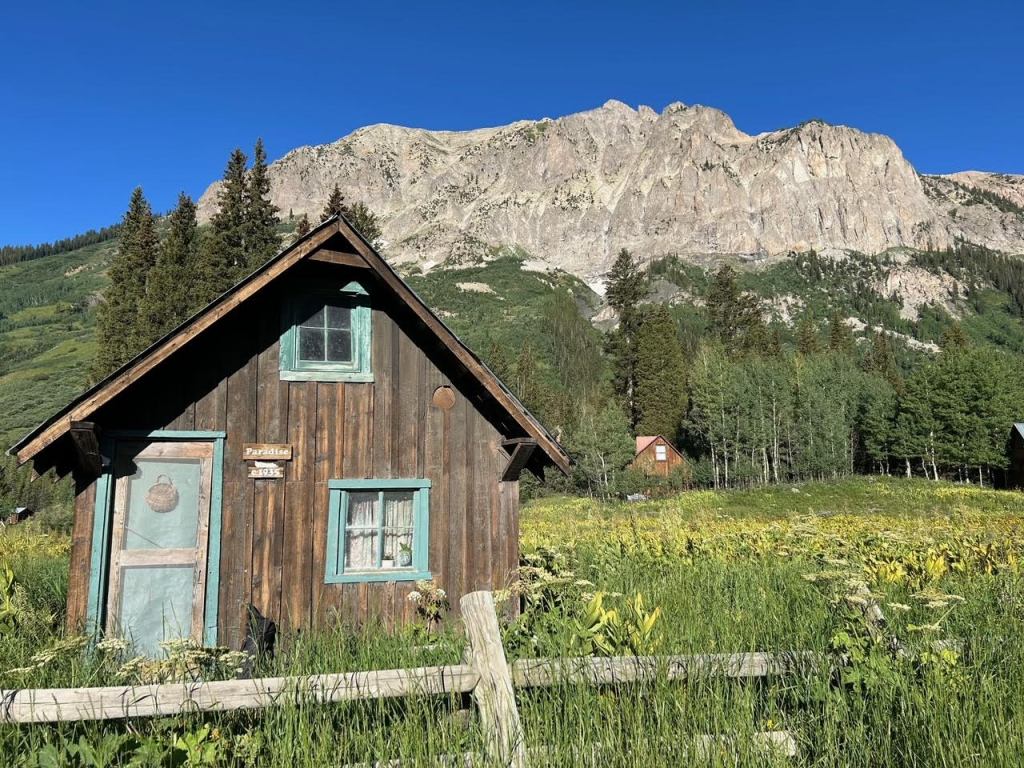
Paradise Cabin at the Rocky Mountain Biological Laboratory near Gothic, Colo. Photo courtesy of Alice Linhart.
 Johnson County Master Gardeners of Iowa