
BY SHARON RUDE
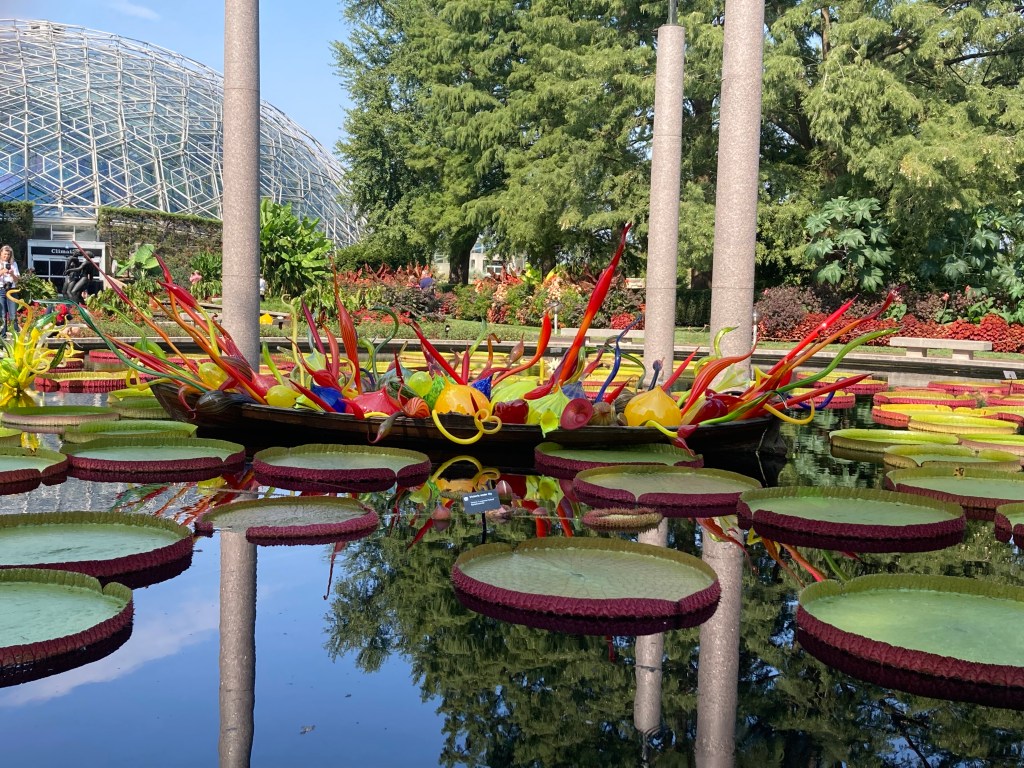
A road trip to the Missouri Botanical Garden has been on my to-do list most of the summer. I was finally able to make it happen Sept. 22 after a busy and hot summer. I was also thrilled to have the opportunity to see another extraordinary exhibit by Dale Chihuly, an amazing glass artist. His large-scale, blown-glass sculptures are designed to mimic nature and plant forms with all their beauty and uniqueness. His sculptures both blend in and stand out wherever they are located among largescale gardens. I’ve seen his exhibits at the Denver Botanic Gardens, Cheekwood Estate and Gardens in Nashville, TN, and Chihuly Garden and Glass in Tacoma, WA. When I learned a Chihuly exhibit was going to be at the Missouri Botanical Garden in St. Louis, MO, May 2 through Oct. 15, I knew I had to make this little trip happen, especially since it was only four hours away!
The Missouri Botanical Garden covers 79 acres in south central St. Louis. It is fairly easy to locate once you are within the St. Louis city limits (thanks to the Google Maps app). Founded in 1859, the garden is the nation’s oldest botanical garden in continuous operation and is also a national historic landmark. There are two additional gardens outside the city limits — the Sophia M. Sachs Butterfly House in Chesterfield’s Faust Park and Shaw Nature Reserve in Gray
Summit.
Plan to spend the majority of the morning and afternoon touring the gardens. The Stephen and Peter Sachs Museum is located on the grounds and includes an intricately painted botanical mural on the ceiling. A narrated tram tour is also available for anyone who prefers to ride through the gardens.
Different areas of the gardens include a rose garden, home garden, children’s garden, xeriscaping, hosta gardens, and iris and daylily gardens. Naturally no iris or daylilies were in bloom this time of year. I can only imagine how beautiful it would have been to see all of the varieties in bloom earlier in the spring and summer. The number of labeled cultivars was amazing. The gardens also included redwoods (I’m sure not nearly as big as the California Redwoods, but still big nonetheless). I learned from signage that cedar trees grown in the swamp areas of the country grow their own “knees,” which look like tall rocks a few feet from the trunk in order to help absorb oxygen into their root systems. I’ve heard of Autumn Crocus and was surprised to see a lawn full of them. The giant Victoria water lilies were enormous at roughly 24 inches across.
In every area of the garden, a variety of bees and butterflies enjoyed the smorgasbord of flowers. A majority of flowering perennials were supporting bee habitat. Monarchs, swallowtails, yellow and white garden butterflies, and a variety of bees were all enjoying the garden.
The Botanical Garden has done an excellent job of anticipating visitor questions with park signage. The gardens not only included signage with plant names and the locations worldwide where they commonly grow, but also interesting facts about the most unusual plants. Some signs included websites where visitors can find plants if they would like to purchase something for their own gardens.
The Climatron is a climate-controlled dome which includes tropical and rainforest plants. It also includes plants endangered due to climate change, invasive pests, or other human activities.
If you are up for a road trip, I highly recommend taking a couple of days (allowing for a day at the gardens and travel time) to visit the Missouri Botanical Garden. Visit its website www.mobot.org for more details. Admission to the garden is currently $14 per person.
 Johnson County Master Gardeners of Iowa